What Is Remortgage

A mortgage deal can feel fixed once the keys are in hand, but it does not have to stay the same forever. Many homeowners reach a point where their current loan no longer suits them. That is where a remortgage comes in.
A remortgage means replacing your existing mortgage with a new one, either with your current lender or a different lender. The property stays the same. The loan changes.
People often remortgage to get a better interest rate, avoid moving onto a lender’s standard variable rate, borrow more against their home, or change the length of their mortgage term. It can save money, but it can also come with fees and risks, so it needs careful thought.
This article is for general information only and is not personal financial advice.

What does remortgage mean?
A remortgage is the process of taking out a new mortgage on a property you already own. The new mortgage pays off the old one, then continues under the new terms.
There are two common routes:
Switching to a new lender
Product transfer with the same lender
You move your mortgage from one lender to another. The new lender pays off the balance with your old lender.
You stay with your current lender but move to a new mortgage deal. This is often simpler, though not always the cheapest option.
For example, someone might have £180,000 left on a mortgage. Their current fixed-rate deal is ending soon. Rather than moving to the lender’s standard variable rate, they apply for a new fixed-rate deal for the same remaining balance.
That is a remortgage.
Why do people remortgage?
The most common reason is to avoid paying more than necessary. Many mortgage deals, especially fixed-rate or tracker deals, last for a set period. When that deal ends, the mortgage often moves to the lender’s standard variable rate, known as the SVR. This rate can be higher than other available deals.
People also remortgage for other reasons.
To get a better interest rate
If rates available in the market are lower than the current deal, remortgaging may reduce monthly payments. Even a small change in rate can make a noticeable difference on a large loan.
The saving depends on:
The outstanding mortgage balance
The new interest rate
The remaining mortgage term
Any fees or charges
Whether early repayment charges apply
To fix payments for certainty
Some homeowners prefer the security of a fixed-rate mortgage. It makes monthly payments predictable for a set period, such as two, five, or ten years.
This can help with budgeting, especially when wider interest rates feel uncertain.
To borrow more money
Some people remortgage to release equity from their home. This means borrowing more than the current mortgage balance.
Common reasons include:
Home improvements
Debt consolidation
Helping a family member
Funding a large planned expense
Borrowing more increases the debt secured against the property. If payments become unaffordable, the home may be at risk.
To change the mortgage term
A remortgage can also be used to adjust the length of the loan.
A longer term may reduce monthly payments, but it usually means paying more interest overall. A shorter term may increase monthly payments, but it can reduce the total interest paid.
How does a remortgage work?
The process is similar to applying for a mortgage, but it is usually more straightforward because the property is already owned.
Here is the typical path.
Check the current mortgage deal
Start with the existing mortgage. Key details include:
Current interest rate
Outstanding balance
Remaining term
Date the current deal ends
Early repayment charge
Exit fee or admin fee
The deal end date matters. Starting too early could trigger a charge. Leaving it too late could mean falling onto the SVR.
Many people begin looking around several months before their current deal ends.
Compare available deals
Next, compare remortgage deals from the current lender and other lenders. The lowest interest rate is not always the cheapest deal overall.
Look at the full cost, including:
Arrangement fees
Valuation fees
Legal fees
Cashback offers
Free legal work
Early repayment charges
Flexibility for overpayments
A deal with a slightly higher rate but lower fees may work out cheaper, especially on a smaller mortgage.
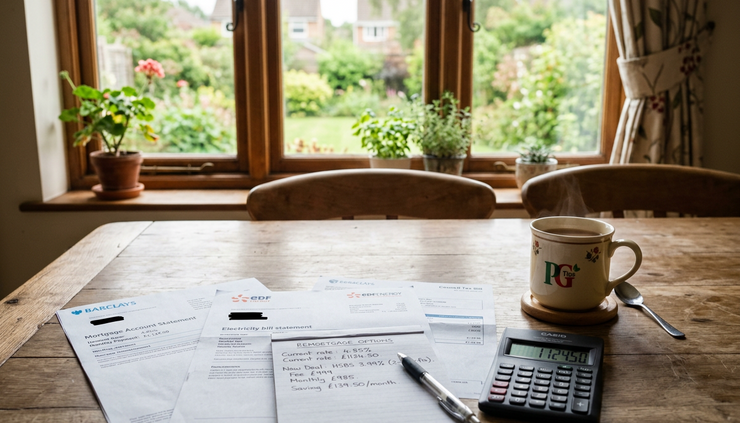
Apply for the new mortgage
Once a deal is chosen, the lender assesses the application. This usually includes:
Income and employment checks
Credit history
Affordability assessment
Property valuation
Details of current mortgage balance
The lender wants to know that the borrower can afford the new payments and that the property is suitable security for the loan.
Complete the legal work
If the remortgage involves a new lender, legal work is needed to move the mortgage charge from the old lender to the new one. Some lenders include free standard legal work as part of the deal.
If staying with the same lender through a product transfer, the process is often quicker and may not need full legal work or a new affordability check.
The old mortgage is paid off
On completion, the new lender pays off the old mortgage. From that point, payments are made to the new lender under the new terms.
If extra borrowing is included, the additional funds are usually released after completion.
What costs should you watch for?
A remortgage can save money, but fees can reduce or even wipe out the benefit.
Common costs include:
Early repayment charge A fee for leaving the current deal before it ends.
Arrangement fee A lender fee for the new mortgage deal. This can often be paid upfront or added to the loan.
Valuation fee A charge for assessing the property’s value, though many lenders offer this free.
Legal fee A fee for conveyancing work, often covered by the new lender on standard remortgages.
Exit fee A small administration fee charged by the old lender when the mortgage closes.
The key question is simple: will the new deal save enough money after all costs are included?
Is remortgaging always a good idea?
No. It can be useful, but it is not always the right move.
Remortgaging may be less attractive if:
The early repayment charge is high
The new rate is not much better
Fees are expensive
Income has fallen since the last application
Credit history has worsened
The property has dropped in value
The mortgage balance is small
Equity also matters. Equity is the part of the property owned outright. If the home has risen in value or the mortgage balance has reduced, the loan-to-value ratio may improve. A lower loan-to-value ratio can sometimes open the door to better rates.
If the loan-to-value ratio has worsened, options may be more limited.
Remortgage versus product transfer
A product transfer is not always described as a remortgage, but it serves a similar purpose. The borrower moves to a new deal with the same lender.
The main advantage is simplicity. It can involve less paperwork and may complete quickly. The downside is limited choice, because only one lender’s deals are available.
A full remortgage can offer wider options, but it usually involves more checks and admin.
For many homeowners, it makes sense to compare both before deciding.
The main takeaway
A remortgage changes the loan secured against a home, not the home itself. It can help reduce payments, secure a new rate, borrow more, or adjust the mortgage term.
The best deal is not always the one with the lowest headline rate. Fees, timing, equity, affordability, and future plans all matter.
Before making a decision, check the current mortgage terms, compare the total cost of new deals, and consider getting regulated mortgage advice if the choice is not clear.


Comments